Integrate

Integrate IO The Integrate I/O integrates all data of its source, it is the inverse of the Differentiate operation.

A typical application of the Integrate I/O is when measuring acceleration sensor signals. Integrating the acceleration signal will give a signal representing the speed. Integration of the speed will give the relative position.

Properties

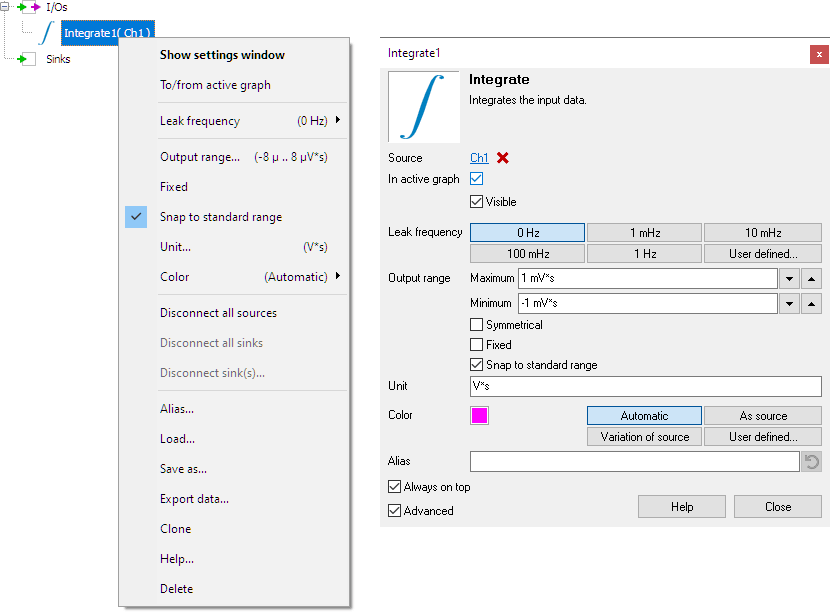
To control the behavior of the Integrate I/O, several properties are available. These can be accessed through a popup menu which is shown when the I/O is right clicked.

Leak frequency

An ideal integrator integrates all frequencies in a signal. In practice, unwanted offsets can cause problems with an ideal integrator. Therefore the integrate I/O contains a leakage parameter, controlled by the Leak frequency property. All frequencies below the leak frequency will be suppressed.

Common properties and actions

Alias

You can change the displayed name of an object by giving it an Alias. This can be handy when you are dealing with a lot of objects and have problems keeping them apart. You can for example give channel one of your instrument the alias "Battery", when it is measuring a battery voltage. To give an object an alias, use the item Alias ... in its menu. To remove an alias and revert to the original name of the object, set the alias to an empty string.

Output range

An I/O has an output range which is based on the output range(s) of the source(s) of the I/O. The default output range is set to a value that will contain all theoretically possible output values of the I/O, based on the input range(s) and the operation the I/O performs. When an I/O is used as source for e.g. a graph, the range of the graph will be set to the output range of the I/O.

To overrule the default output range of an I/O, use the Output range property. A dialog box is opened in which the upper and lower limit of the output range can be entered. To avoid that an auto ranging input will override the manual selected output range, check the Fixed option.

Fixed

When the source of an I/O has an auto ranging feature, the output range of the I/O will follow the output range of the source and be determined again each time the input range changes. To avoid that an auto ranging source will change the output range of an I/O, enable the Fixed property of the I/O.

Snap to standard range

An I/O has an output range which is based on the output range(s) of the source(s) of the I/O. The default output range is set to a value that will contain all theoretically possible output values of the I/O, based on the input range(s) and the operation the I/O performs.

All TiePie engineering instruments have ranges in a 2-4-8 sequence: 2 Volt, 4 Volt, 8 Volt, 20 Volt, 40 Volt, 80 Volt, etc.. The default output range of an I/O is likely to have an output range that does not follow the 2-4-8 sequence. That can make visual comparison of an instrument channel and the output of an I/O in a graph difficult, because they have different ranges. The property Snap to standard range will force the I/O to select an output range that follows the 2-4-8 sequence.

Unit

By default, the unit of most sources and I/O's is V for Volt. You can change the unit of most sources and I/O objects with the item Set unit... in the menu of the object. A string value can be entered in the dialog box that is shown.

Color

When multiple sources or I/O's are displayed in a graph or a meter, they can be distinguished from each other by their Color. Three different color settings are available for a source or an I/O.

  • Automatic
    A color is selected from a group of colors. There are separate groups for channel colors and source colors. The groups can be configured in the program settings. Each new channel or source uses the next available color in the group. When the last color in the group is used and another channel or source is added, picking will start at the top of the group again.
  • As source
    This setting is only available for I/O's. The I/O will use the same color as its source. When multiple sources are connected to the I/O, the color of the first connected source is used.
  • User defined...
    The color of the source or I/O is user selected, using a color picker dialog. Any color can be used.

Disconnect all sources

To disconnect all sources from an I/O or Sink at once, use the Disconnect all sources action.

Disconnect sink(s)

To disconnect one or more sinks from an I/O or Source, use the Disconnect sink(s) action. This will show a dialog that lists all connected sinks. Individual sinks can then be selected and disconnected from the object.

Disconnect all sinks

To disconnect all sinks from an I/O or source at once, use the Disconnect all sinks action.

Clone

When a new object is to be created, similar to an already existing object, with the same properties, the Clone action can be used. This will create an identical copy of the original object, with the exact same properties. Source(s) and sink(s) of the new object are not yet connected.

Delete

The Delete action deletes a source, I/O or sink. All connections of the object will be disconnected and then the object will be removed from the object tree. The source property of the objects that used this object as source will be cleared. The sink property of the objects that used this object as sink will be cleared. An axis in a graph that was connected to this object will be also deleted.

Export data

The Export data action allows to export the data of an object to a file. This is detailed described on the page about Exporting data.

Load

The Load action allows to load the settings and data for an object from a TPS or TPO file. This is detailed described on the page about Loading into selected objects.

Save as

The Save as action allows to save the settings and data of one or more objects to a TPO file. When multiple objects are selected, the connections between the objects are saved as well. This is detailed described on the page about Saving objects to a TPO file.